Timothy hay
Best everyday hayLong, coarse stems with seed heads. The classic choice.
Fiber35.6%
Protein9.1%
Calcium0.33%
Best for: Adult guinea pigs, every day, unlimited.
Showing all 75 foods
All 75 vegetables, fruits and herbs on this list are safe for guinea pigs in the right amount. Each one shows how often to serve it, how much, and what to watch out for.
Before any veggie or fruit, every guinea pig needs unlimited fresh hay, day and night. Here’s why, and how to pick the right one.
Guinea pig teeth never stop growing. Grinding long strands of hay all day wears them down and helps prevent painful overgrown teeth.
Hay’s fiber keeps the digestive system moving. Without enough of it, the gut can slow down or stop (GI stasis), which is an emergency.
Vets recommend grass hay make up about 70–80% of what your guinea pig eats. Pellets and veggies can’t replace it.
Guinea pigs graze for hours. Rummaging through hay keeps them busy, calm and active.
Average fiber, protein and calcium per hay, as % of dry matter. For adults, look for high fiber and low calcium.
Long, coarse stems with seed heads. The classic choice.
Best for: Adult guinea pigs, every day, unlimited.
Softer, leafier blades with a sweet smell.
Best for: Picky eaters, and people allergic to timothy.
Fine, soft stems. Popular in warm climates.
Best for: Adults, as a main hay or mixed with timothy.
Thick golden stalks, often with crunchy seed heads.
Grass hay: high in fiber, low in calcium. Values vary too much between bales for a reliable average.
Best for: Mixing in for variety. The seed heads are tasty, so watch the waistline.
A mix of wild meadow grasses and plants.
Grass hay: nutrition depends on the field it was cut from, so there's no single average.
Best for: Variety and foraging fun alongside timothy.
A legume, not a grass. Leafy and very rich.
Best for: Only pups under 6 months, pregnant or nursing sows, or on vet advice. Its calcium can lead to bladder stones in adults.
Sources: PDSA, Langford Vets, Feedipedia (FAO) averages for timothy, orchard grass, Bermuda grass and alfalfa hay. Real bales vary by harvest and cut.
Serving1-2 small raw pieces, 1-2 times a week
NutritionPer 100 g: vitamin C 5.6 mg (low), calcium 24 mg, 93% water. Good source of vitamin K and folate.
Good to knowIt adds vitamin K and folate. Never feed cooked or buttered asparagus. Feed only the spear, never the berries.
Fun factAsparagus is native to Europe and western Asia. Emperor Augustus said "faster than cooking asparagus."
Serving1-2 small leaves, 1-2 times a week at most
NutritionPer 100 g: vitamin C 28 mg, calcium 99 mg, 91% water. Very high in vitamins K and A.
Good to knowIt's packed with vitamins K and A. Avoid it if your guinea pig had stones. The tender stems are fine to eat.
Fun factSpinach came from ancient Persia. An Arab writer called it chieftain of greens.
Serving1 thin raw slice, 1-2 times a week
NutritionPer 100 g: sugar 5-7 g, fiber 3 g, vitamin C 4.9 mg (low), calcium 16 mg. Good source of folate.
Good to knowA thin slice adds fiber and folate. Avoid big pieces of sweet beetroot. Red pee may just be beet color. Go easy on the leafy beet tops.
Fun factBeets come from wild sea beet. People first grew them for their leaves.
Serving2-3 thin slices a day
NutritionPer 100 g (red): vitamin C 128-142 mg, top of our veggie list. Low calcium (about 7 mg), 92% water. Also vitamins A and B6.
Good to knowIts vitamin C helps prevent scurvy. Never feed spicy or hot peppers. Remove the stem and seeds first.
Fun factPeppers first grew in Central and South America. Some Midwesterners call bell peppers mangoes!
Serving1-2 small pieces, 1-2 times a week, if tolerated
NutritionPer 100 g: vitamin C 30-45 mg, calcium 62-105 mg, 94% water. Also folate and vitamin K.
Good to knowIt's 94% water with good vitamin C. It can cause gas and bloating. Stop if the belly looks swollen. Both the leaves and stalks are fine.
Fun factChina has grown bok choy since the 400s. Its Cantonese name means white vegetable.
Serving1-2 small florets, 1-2 times a month
NutritionPer 100 g: vitamin C 89 mg, calcium 47 mg, 89% water. Very high in vitamin K.
Good to knowA floret brings lots of vitamin C. Avoid it if your guinea pig bloats easily. The leaves and stalk are safe too.
Fun factBroccoli was bred from wild cabbage in Italy. Italian immigrants brought it to America.
Serving1 small sprout, up to twice a week
NutritionPer 100 g: vitamin C 85 mg, calcium 42 mg, 86% water. Very high in vitamin K.
Good to knowThey're rich in vitamins C and K. Avoid them if your guinea pig gets gassy. Loose outer leaves are fine to share.
Fun factThey were grown near Brussels by the 1200s. French settlers grew them in Louisiana.
Serving1-2 small pieces, 1-2 times a week, if tolerated
NutritionPer 100 g: vitamin C 37 mg, calcium 40 mg, 93% water. High in vitamin K.
Good to knowIt adds vitamin C and vitamin K. Cabbage can cause gas and bloating. Stop if your guinea pig stops eating. Skip the hard core, feed the leaves.
Fun factEurope was farming cabbage before 1000 BC. Its name comes from caboche, French for head.
Serving1-2 baby-carrot-sized pieces, 3-4 times a week
NutritionPer 100 g: sugar 4.7 g, fiber 3 g, vitamin C 5.9 mg (low), calcium 33 mg. Very high in vitamin A.
Good to knowThey're very high in vitamin A. Avoid big chunks, carrots are sugary. Carrot tops are safe to eat too.
Fun factCarrots were first grown in Iran and Afghanistan. Early carrots were purple, yellow, or white.
Serving1 small floret, 1-2 times a week
NutritionPer 100 g: vitamin C 48 mg, calcium 22 mg, 92% water. Also vitamin K and B5.
Good to knowIt offers vitamin C and vitamin K. Cauliflower can cause gas and bloating. Stop if your guinea pig acts hunched. The green leaves are safe to eat too.
Fun factCauliflower came from the Mediterranean 2,500 years ago. Its Italian name means cabbage flower.
Serving1/4 to 1/2 stalk with leaves, daily
NutritionPer 100 g: vitamin C 3.1 mg (low), calcium 40 mg, 95% water. Good source of vitamin K.
Good to knowIt's 95% water and great for hydration. Don't serve long strings in one piece. Cut celery into 1-inch pieces. The leafy tops are safe to eat.
Fun factCelery has been eaten since ancient Greek times. Celery garlands were found in Tutankhamun's tomb.
Serving1-2 tablespoons of kernels or a small piece of husk and silk, 1-2 times a week
NutritionPer 100 g kernels: sugar about 6 g, very low calcium. The husk is mostly fiber.
Good to knowThe husk and silk add fiber. Never feed canned, cooked, or frozen corn. Kernels are full of sugar and starch. Feed inner husks, not the outer ones.
Fun factSweet corn began as a natural mutation. The first recorded sweet corn was called Papoon.
Serving2-3 slices a day
NutritionPer 100 g: 95% water, vitamin C 2.8 mg (low), calcium 16 mg. Some vitamin K.
Good to knowIt's 95% water, a cool summer snack. Too much cucumber means soft poops. Don't let it replace leafy greens. The skin and seeds are fine to eat.
Fun factIndia grew cucumbers 3,000 years ago. Emperor Tiberius reportedly ate them year-round.
Serving1-2 leaves a day
NutritionPer 100 g (curly endive): vitamin C 6.5 mg, calcium 52 mg. Very high in vitamin K and folate.
Good to knowIt brings lots of vitamin K and folate. Don't overdo curly endive, it has more calcium. Both green and pale leaves are fine.
Fun factBelgium developed Belgian endive in the mid-1800s. Legend says stored roots sprouted by accident.
Serving2-3 thin bulb slices plus fronds, 3-4 times a week
NutritionPer 100 g bulb: vitamin C about 15 mg, calcium about 41 mg, sugar 3 g, 93% water.
Good to knowIts fronds add flavor and variety. Don't panic if your guinea pig refuses it. Fennel has a strong licorice taste. The bulb, stalks, and fronds are safe.
Fun factFennel is native to the Mediterranean shores. In Greek, fennel is called marathon.
Serving1-2 beans, 1-2 times a week
NutritionPer 100 g: vitamin C 12 mg, calcium 37 mg, 90% water. Also vitamin K.
Good to knowThey add vitamin K and some vitamin C. Never feed canned or cooked green beans. They can also cause gas. Serve the whole fresh pod, raw.
Fun factGreen beans came from Central and South America. The stringless bean was bred in 1894.
Serving1-2 leaves, 1-2 times a week max
NutritionPer 100 g: vitamin C 120 mg, calcium 150 mg. Extremely high in vitamin K.
Good to knowIt's one of the top vitamin C greens. Avoid feeding kale every day. Its calcium can add to bladder sludge. The stems are fine, cut them small.
Fun factKale came from the eastern Mediterranean and Turkey. Germans hold winter kale hikes called Kohlfahrt.
Serving1 small piece, up to twice a week
NutritionPer 100 g: sugar about 5 g, fiber about 5 g, vitamin C 17 mg, calcium 36 mg.
Good to knowIt adds fiber and some vitamin C. Parsnips are as sugary as carrots. Avoid the leaves, feed only the root.
Fun factParsnips are native to Europe and Asia. Before cane sugar, Europeans used them as sweetener.
Serving1-2 leaves, 3-4 times a week
NutritionPer 100 g: vitamin C 8 mg, calcium 19 mg. Very high in vitamin K.
Good to knowIt's very high in vitamin K. Don't worry if your guinea pig refuses it. Radicchio tastes bitter at first. The whole leaf, veins included, is fine.
Fun factRadicchio comes from Italy's Veneto region. A Belgian agronomist perfected red radicchio in 1860.
Servingpart of the 1/2 to 3/4 cup of lettuce a day
NutritionPer 100 g: vitamin C 4-9 mg (low), calcium about 43 mg, 95% water, almost no sugar.
Good to knowIt's 95% water with almost no sugar. Don't count on it for vitamin C. Add new lettuce slowly to avoid soft poops. The whole leaf, rib and all, is fine.
Fun factLettuce was first domesticated near the Caucasus. Egyptians grew it for seed oil first.
Serving1/2 to 3/4 cup a day
NutritionPer 100 g: vitamin C 4.6 mg (low), calcium 35 mg, 95% water. Rich in vitamins A and K.
Good to knowIt's rich in vitamins A and K. Never swap romaine for iceberg lettuce. Iceberg can cause soft, runny poops. The whole leaf, rib included, is fine.
Fun factRomaine's British name, cos, may come from Kos. Egyptians linked lettuce to their fertility god Min.
Serving1-2 leaves, 1-2 times a week max
NutritionPer 100 g: vitamin C 28 mg, calcium 99 mg. Huge vitamin K, plus vitamin A and folate.
Good to knowIt's loaded with vitamins K and A. Avoid spinach if your guinea pig had stones. The stems are as safe as leaves.
Fun factSpinach reached Sicily with the Arabs in 827. Popeye's iron story is an urban legend.
Serving1 thin raw slice, about once a month
NutritionPer 100 g: sugar about 4 g, fiber about 3 g, calcium about 30 mg. Very high in vitamin A.
Good to knowIt's very high in vitamin A. Never feed cooked, baked, or boiled sweet potato. Peel it and serve only raw flesh.
Fun factCentral Americans grew sweet potatoes 5,000 years ago. New Zealanders call them kumara.
Serving1-2 cherry tomatoes or a small wedge, 1-2 times a week
NutritionPer 100 g: 95% water, vitamin C about 14 mg, low calcium.
Good to knowIt's juicy, with some vitamin C. Avoid green, unripe tomatoes completely. Never feed tomato leaves, stems, or vines.
Fun factTomatoes came from western South America. Italians first called them golden apples.
Serving1 small piece of root or 1-2 leaves, 1-2 times a week
NutritionPer 100 g root: vitamin C about 27 mg, calcium about 33 mg, sugar 4-5 g, 91% water.
Good to knowThe root adds vitamin C and water. Don't overfeed turnips, they can cause gas. The greens are safe but high calcium.
Fun factTurnips were domesticated in Central Asia long ago. Irish and Scots carved turnips into lanterns.
Serving1-2 slices, 3-4 times a week
NutritionPer 100 g: vitamin C 18 mg, calcium 16 mg, sugar 2.5 g, 95% water.
Good to knowIt's 95% water with some vitamin C. Never serve zucchini cooked or seasoned. Too much can cause soft poops. The skin is fine, no need to peel.
Fun factZucchini was bred in Milan in the 1800s. The British and French call it courgette.
Serving1 small cube, 1-2 times a week
NutritionPer 100 g: sugar 10.4 g, fiber 2.4 g, vitamin C 4.6 mg (low), calcium 6 mg.
Good to knowIts skin and flesh add fiber. Never feed apple seeds or the core. Seeds contain a compound that releases cyanide. Apple tree leaves and twigs are safe.
Fun factApples came from the mountains of Central Asia. The apple a day saying is Welsh.
Serving1 small piece, pitted, once a week
NutritionPer 100 g: sugar 6-9 g, fiber 1.5 g, calcium about 12 mg, some vitamin A.
Good to knowIt adds a little vitamin A. Avoid dried apricots, they're packed with sugar. Never feed the pit, it's toxic.
Fun factApricots were domesticated in Central Asia and China. US Marines think apricots bring bad luck.
Serving1 coin-sized slice, once a week
NutritionPer 100 g: sugar 12-16 g, vitamin C about 9-12 mg, potassium 358 mg. Rich in vitamin B6.
Good to knowIt's rich in vitamin B6 and potassium. Don't overfeed, banana can cause constipation. A little washed peel is safe too.
Fun factBananas were probably first domesticated in New Guinea. Botanically, a banana is a berry.
Serving1-2 berries, 1-2 times a week
NutritionPer 100 g: fiber 5.3 g, sugar 5-7 g, vitamin C 15-21 mg. High in manganese.
Good to knowThey're high in fiber and manganese. Avoid wild berries near roads or sprays. Don't forget, they still have sugar. Blackberry leaves are safe for guinea pigs too.
Fun factBlackberries grow wild in Europe, Asia, and America. Folklore says the devil spoils them after Michaelmas.
Serving1-2 blueberries, 1-2 times a week
NutritionPer 100 g: sugar about 10 g, fiber 2.4 g, vitamin C 8-10 mg, very low calcium. Good vitamin K.
Good to knowThey add a little vitamin K. Avoid dried or yogurt-coated blueberries. Serve the whole fresh berry, skin included.
Fun factBlueberries are native to North America. A farmer and botanist tamed them by 1916.
Serving1 small cube, 1-2 times a week
NutritionPer 100 g: sugar about 8 g, 90% water, vitamin C 11-37 mg (tests vary). Good vitamin A.
Good to knowIt's 90% water with good vitamin A. Don't overfeed, it's full of sugar. Remove the seeds and rind before serving.
Fun factCantaloupe may come from South Asia or Africa. A moldy cantaloupe helped mass-produce penicillin.
Serving1 pitted cherry, once a week
NutritionPer 100 g (sour cherries): sugar 8.5 g, fiber 1.6 g, vitamin C 10 mg, calcium 16 mg.
Good to knowThey add a little vitamin C. Don't overfeed, cherries are a sweet treat. Never feed pits, stems, or cherry leaves. They contain compounds that release cyanide.
Fun factCherries are named after Kerasous, near Giresun, Turkey. Lucullus brought a cultivated cherry to Rome.
Serving1 small slice of fresh fig, once a week
NutritionPer 100 g: sugar 16.3 g, fiber 2.9 g, calcium 35 mg, vitamin C 2 mg.
Good to knowIt adds fiber and some calcium. Never feed dried figs, they're super sugary. Skip fig leaves, their sap irritates skin.
Fun factFigs may be the first plant humans farmed. Adam and Eve wore fig leaves in Genesis.
Serving1 seedless grape, halved, once a week max
NutritionPer 100 g: sugar 15.5 g, fiber 0.9 g, vitamin C 3.2 mg, calcium 10 mg.
Good to knowThey're juicy and full of water. Grapes are toxic to dogs, stay cautious. Never feed raisins, they're packed with sugar. Choose seedless grapes and cut them in half.
Fun factGrapes were first farmed in the Middle East. Wine making in Georgia dates back 8,000 years.
Serving1 small slice, seeds removed, once a week
NutritionPer 100 g: vitamin C 228 mg, fiber 5.4 g, sugar 8.9 g, calcium 18 mg.
Good to knowIt's packed with vitamin C and fiber. Don't overfeed, it's sweet and acidic. Remove the hard seeds before serving.
Fun factGuava came from Mexico and Central America. Its name comes from the Taino language.
Serving1 small cube, 1-2 times a week
NutritionPer 100 g: 90% water, vitamin C 16-18 mg, sugar 7-8 g, calcium 6 mg.
Good to knowIt's 90% water, a juicy summer treat. Don't overfeed, it can cause soft poops. Remove the seeds and rind before serving.
Fun factHoneydew traces to North Africa and southern Europe. Its American name replaced the French White Antibes.
Serving1 thin peeled slice, 1-2 times a week
NutritionPer 100 g: vitamin C 75-93 mg, sugar 9 g, fiber 3 g, calcium 35 mg. Also vitamins K and E.
Good to knowIt's packed with vitamin C. Don't overfeed, the acid can cause mouth sores. Always peel kiwi before serving.
Fun factKiwifruit is native to central and eastern China. Its Chinese name means macaque peach.
Serving1 small cube of peeled flesh, once a week
NutritionPer 100 g: sugar 13.7 g, vitamin C 36 mg, fiber 1.6 g, calcium 11 mg.
Good to knowIt adds a good dose of vitamin C. Don't overfeed, mango is very sugary. Never feed the skin or the pit.
Fun factMangoes came from Myanmar, Bangladesh, and northeastern India. Mango is India's national fruit.
Serving1 small slice, pitted, once a week
NutritionPer 100 g: sugar 7.9 g, fiber 1.5 g, vitamin C about 3 mg (low), very low calcium.
Good to knowIt adds a little fiber. Don't overfeed, the acid can cause mouth sores. Never feed the pit, it's toxic.
Fun factNectarines are smooth-skinned peaches, first grown in China. They are not peach-plum hybrids.
Serving1 small segment, 1-2 times a week
NutritionPer 100 g: vitamin C 53 mg, sugar 9.4 g, fiber 2.4 g, calcium 40 mg.
Good to knowIt's a good source of vitamin C. Don't overfeed oranges, the acid can cause sores. Remove the seeds and skip the peel.
Fun factOranges began in southern China and northeast India. The color orange was named after the fruit.
Serving1 small cube of ripe flesh, once a week
NutritionPer 100 g: vitamin C 61 mg, sugar 7.8 g, fiber 1.7 g, calcium 20 mg.
Good to knowIt's a good source of vitamin C. Never feed unripe green papaya. Remove the seeds and skin first.
Fun factPapaya comes from southern Mexico and Central America. Its name comes from Arawakan languages.
Serving1 small slice, pitted, once a week
NutritionPer 100 g: sugar 8.4 g, fiber 1.5 g, vitamin C about 4 mg (low), low calcium.
Good to knowIt adds a little fiber. Don't overfeed, the acid can cause mouth sores. Never feed the pit, it's toxic.
Fun factPeaches were domesticated in China around 6000 BCE. Their Latin name wrongly points to Persia.
Serving1 thin slice, cored, 1-2 times a week
NutritionPer 100 g: sugar 9.8 g, fiber 3.1 g, vitamin C 4.3 mg, calcium 9 mg.
Good to knowIt's a good source of fiber. Pears are sweet, so avoid big pieces. Never feed the seeds or the core. Pear tree leaves and twigs are safe.
Fun factPears first grew in Central Asia's mountains. Americans renamed the Williams pear Bartlett by mistake.
Serving1 small cube, once a week or less
NutritionPer 100 g: vitamin C 48-59 mg, sugar 10-11 g, calcium 13 mg. High in manganese.
Good to knowIt's rich in vitamin C and manganese. Pineapple is very acidic, so avoid overfeeding. Never feed the skin, core, or leaves.
Fun factPineapple is native to South America. Columbus first saw one on Guadeloupe in 1493.
Serving1 small slice, pitted, once a week
NutritionPer 100 g: sugar 9.9 g, fiber 1.4 g, vitamin C 9.5 mg, calcium 6 mg.
Good to knowIt adds some vitamin C. Avoid big pieces, plums are sugary. Never feed the plum pit, it's toxic.
Fun factPlums were likely among the first fruits domesticated. A dried plum is called a prune.
Serving1 small raw cube, 1-2 times a week
NutritionPer 100 g: sugar 2.8 g, vitamin C 9 mg, calcium 21 mg. Rich in vitamin A.
Good to knowIt's rich in vitamin A. Never feed old jack-o-lanterns, they can mold. Avoid canned pumpkin pie filling too. Skip the seeds, feed the raw flesh.
Fun factMexico was farming pumpkins over 8,000 years ago. Irish and British people once carved turnip lanterns.
Serving1-2 berries, 1-2 times a week
NutritionPer 100 g: fiber 6.5 g, sugar 4.4 g, vitamin C 26 mg, calcium 25 mg.
Good to knowThey're high in fiber and vitamin C. Wash berries well, they hold pesticides. Don't overfeed, they're still sweet. Raspberry leaves are safe for guinea pigs too.
Fun factRed raspberries come from Europe and northern Asia. Their Latin name honors Mount Ida in Turkey.
Serving1 small raw cube, 1-2 times a week
NutritionPer 100 g: sugar 2.2 g, fiber 1.5 g, vitamin C 12 mg, calcium 28 mg.
Good to knowIt adds vitamin C and fiber. Never feed cooked squash, only raw. Remove the hard rind and seeds.
Fun factSquash was domesticated in Mexico 8,000 years ago. Its name comes from the Narragansett askutasquash.
Serving1 slice, 1-2 times a week
NutritionPer 100 g: vitamin C 59 mg, sugar 4.9 g, fiber 2 g, calcium 17 mg.
Good to knowIt's a good source of vitamin C. Wash strawberries well, they're heavily sprayed. Don't overfeed, they're still a sweet treat. The green leafy tops are safe too.
Fun factGarden strawberries were first bred in Brittany, France. Its seeds are actually tiny fruits called achenes.
Serving1 small segment, once a week
NutritionPer 100 g: vitamin C 27 mg, about 85% water. It's sweet citrus, so keep it rare.
Good to knowIt adds a little vitamin C. Don't overfeed, citrus acid can cause sores. Remove the seeds and skip the peel.
Fun factTangerines are a type of mandarin orange. Their name comes from Tangier, Morocco.
Serving1 small cube, 1-2 times a week
NutritionPer 100 g: 91% water, sugar about 6-7 g, very low fiber and calcium.
Good to knowIt's 91% water, great on hot days. Don't overdo it, it can cause soft poops. Remove the seeds before serving.
Fun factWatermelon was first cultivated in Africa. Its likely ancestor is Sudan's Kordofan melon.
Serving1 small sprig, now and then
Nutritionno reliable data exists for the fresh leaf, so keep it rare.
Good to knowFresh leaves add new flavor and variety. Never feed anise seeds or anise oil. Only the fresh green leaf is okay.
Fun factAnise is native to the eastern Mediterranean. Egyptians have grown it for 4,000 years.
Serving1-2 leaves, 2-3 times a month
NutritionPer 100 g: calcium 160 mg, vitamin C 15 mg, 92% water. High in vitamin K and folate.
Good to knowIt adds vitamin K and folate. Arugula is high in calcium. Avoid big portions, it can cause gas. The leaves and tender stems are fine.
Fun factRomans ate arugula raw in salads. Americans say arugula, Brits say rocket.
Serving1-2 leaves, 2-3 times a month
NutritionPer 100 g: calcium 177 mg, vitamin C 18 mg. Extremely high in vitamin K.
Good to knowIt's extremely high in vitamin K. Basil is very high in calcium. Don't feed it often, calcium adds up. Leaves and soft stems are both safe.
Fun factBasil grows wild from Africa to Southeast Asia. Its Greek name means royal plant.
Serving1 small sprig, 1-2 times a week
NutritionUSDA lists no data for carrot greens, so keep portions small.
Good to knowThey add fresh greens and variety. Don't feed them every single day. The carrot root is safe too.
Fun factIran's first carrots were grown for their leaves. The orange root came much later.
Servinga few fresh leaves, up to twice a week
Nutritionno reliable fresh-leaf data exists, so keep it small.
Good to knowIt adds mild flavor and variety. Never forage wild chervil look-alikes. Buy it from a store instead. The leaves and soft stems are safe.
Fun factChervil is native to the Caucasus region. It's one of France's four fines herbes.
Serving1-2 leaves, up to twice a week
NutritionPer 100 g leaves: vitamin C 24 mg, 92% water, moderate calcium. Very high in vitamin K.
Good to knowIts leaves are very high in vitamin K. Avoid picking it near roads. Feed only leaves, never chicory coffee or root.
Fun factChicory comes from Europe, Africa, and western Asia. Folklore said chicory could make you invisible.
Servinga generous sprig, daily
NutritionPer 100 g: vitamin C 27 mg, calcium 67 mg, 92% water. Very high in vitamins K and A.
Good to knowIt's a great daily herb with vitamin C. Don't feed it unwashed, it can hold grit. Leaves and stems are safe, not seeds.
Fun factCoriander seeds were found in Tutankhamun's tomb. Some people's genes make cilantro taste soapy.
Serving1-2 leaves or a flower, up to twice a week
NutritionPer 100 g: calcium 187 mg, vitamin C 35 mg, fiber 3.5 g. High in vitamins A and K.
Good to knowThe greens bring vitamins A and K. Never pick dandelions from sprayed lawns or roads. The greens are high in calcium. Leaves, flowers, and roots are all safe.
Fun factDandelions originally came from Eurasia. Its French name pissenlit means wet the bed.
Serving1 small sprig, 2-3 times a month
NutritionPer 100 g: vitamin C 85 mg, calcium 208 mg. Also vitamin A and folate.
Good to knowIt's a strong source of vitamin C. Dill is very high in calcium. Don't overfeed, guinea pigs love it too much. The feathery leaves and soft stems are safe.
Fun factDill comes from North Africa and West Asia. Dill was found in Pharaoh Amenhotep II's tomb.
Servinga few fresh leaves, up to twice a week
Nutritionno reliable fresh-leaf data exists, so keep it small.
Good to knowFresh leaves add a lemony change. Don't treat a nervous guinea pig with it. Never feed lemon balm tea or oil. Only the fresh leaves are okay.
Fun factLemon balm comes from southern Europe and Iran. People believed bees never left its garden.
Serving1 small sprig, up to twice a week
Nutritionno reliable fresh-leaf data exists, so keep it small.
Good to knowIt adds fresh flavor and variety. Marjoram is strong, like oregano. Avoid feeding it every day. Feed soft leaves, skip woody stems.
Fun factMarjoram comes from Cyprus, Turkey, and the Mediterranean. Ancient Greeks believed Aphrodite created marjoram.
Serving1-2 leaves, 2-3 times a month
NutritionPer 100 g (spearmint): calcium 199 mg, fiber 6.8 g, vitamin C 13 mg.
Good to knowIt's high in fiber, with some vitamin C. Mint is very high in calcium. Never feed peppermint oil, tea, or candy. Leaves and soft stems are both safe.
Fun factMint grows wild on almost every continent. Myth says the nymph Minthe became mint.
Servinga small handful a day, once your guinea pig is used to it
Nutritionyoung grass is mostly water and fiber. It never replaces hay.
Good to knowFresh grass is mostly water and fiber. Don't switch to oat grass all at once. Too much too fast can cause soft poops. Feed fresh blades, not the seed heads.
Fun factOats began as a weed in wheat fields. Johnson's dictionary said oats fed Scotland's people.
Serving1 small sprig, 2-3 times a month
Nutritionno reliable fresh-leaf data. Dried-spice numbers don't apply.
Good to knowFresh leaves add strong flavor and variety. Never feed dried oregano or oregano oil. Only fresh leaves and soft tips are okay.
Fun factOregano is native to the Mediterranean region. Greek myth says Aphrodite created it for happiness.
Serving1-2 sprigs, 1-2 times a week
NutritionPer 100 g: vitamin C 133 mg, calcium 138 mg, 88% water. Extremely high in vitamin K.
Good to knowIt's loaded with vitamin C. Parsley is high in calcium. Avoid it daily for adult guinea pigs. The stems are as safe as leaves.
Fun factParsley comes from Greece and the Balkans. Its Greek name means rock celery.
Serving1 small sprig, 1-2 times a week
Nutritionradish greens are edible, but USDA lists no data for them.
Good to knowThe leaves add fresh greens and variety. Don't feed them every day. The root is safe, but spicy.
Fun factRadishes likely originated in Southeast Asia. Herodotus said pyramid workers ate radishes.
Serving1-2 leaves, up to twice a week
Nutritionno reliable fresh-leaf data exists, so keep portions small.
Good to knowThey add fresh, leafy variety. Don't use raspberry leaves as medicine. Ask your vet about pregnant sows. The berries are safe treats too.
Fun factThe leaves come from raspberry canes. Herbal teas use them for an astringent taste.
Serving1 small cleaned piece, once a week
NutritionPer 100 g (wild): vitamin C about 426 mg, the highest on our list.
Good to knowThey're the top vitamin C food here. Never feed the hairy seeds inside. Those hairs were once used as itching powder. Serve only the cleaned outer shell.
Fun factRosehips are the fruit of the rose plant. British schoolchildren gathered them during World War II.
Serving1 small sprig, up to twice a week
NutritionPer 100 g: calcium 317 mg, fiber 14 g, vitamin C 22 mg, 68% water.
Good to knowIt's very high in fiber. Rosemary is very high in calcium and oils. Avoid the woody stems, feed soft tips.
Fun factRosemary is native to the Mediterranean region. Its Latin name means dew of the sea.
Serving1 small leaf, occasionally
Nutritionno reliable fresh-leaf data. Keep it the rarest herb in the bowl.
Good to knowA tiny leaf adds new flavor. Sage oil contains thujone, a nerve toxin. Never feed dried sage or smudge sticks.
Fun factSage is native to the Mediterranean region. Romans called it the holy herb.
Serving1 small sprig, up to twice a week
Nutritionno reliable fresh-leaf data exists, so keep it small.
Good to knowFresh sprigs add flavor and variety. Tarragon contains estragole, a strong oil. Never feed the dried spice version.
Fun factTarragon grows wild across Eurasia and North America. Its name dracunculus means little dragon.
Serving1 small sprig, up to twice a week
NutritionPer 100 g: vitamin C about 180 mg, fiber 14 g, high calcium (databases differ).
Good to knowIt's rich in vitamin C and fiber. Thyme is very high in calcium. Avoid woody stems, feed only soft tips.
Fun factThyme is native to the Mediterranean region. Medieval people slept on thyme to stop nightmares.
Serving1-2 sprigs, 3-4 times a week
NutritionPer 100 g: 95% water, vitamin C about 43 mg. Very high in vitamin K.
Good to knowIt's 95% water and high in vitamin K. Never feed wild watercress, it may carry parasites. It can also cause gas. Leaves and tender stems are both safe.
Fun factWatercress is native to Eurasia. Romans believed it could cure mental illness.
No food matches that search. If it’s not on this list, check The Never Ever List before feeding it, or ask your vet.
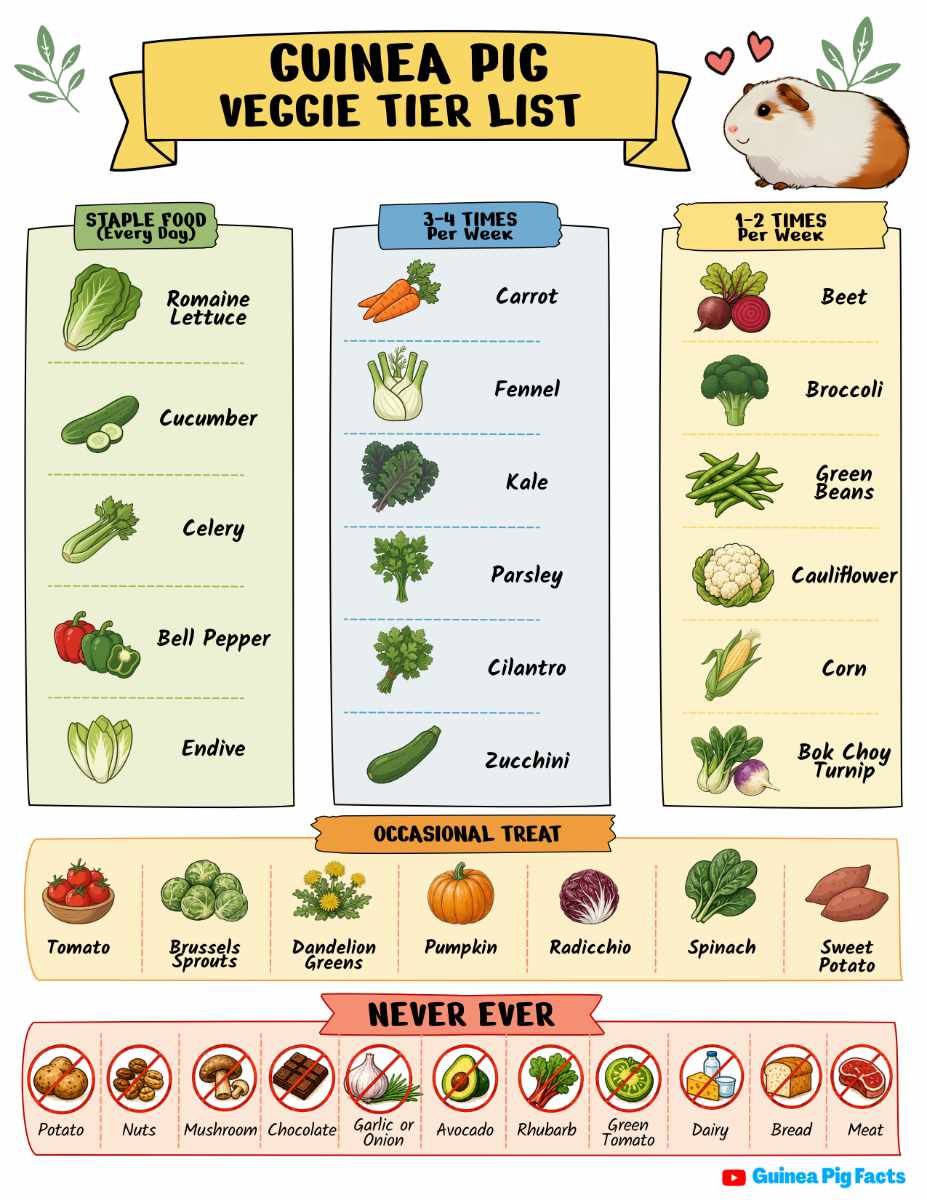
The everyday, weekly and treat veggies on one printable page.
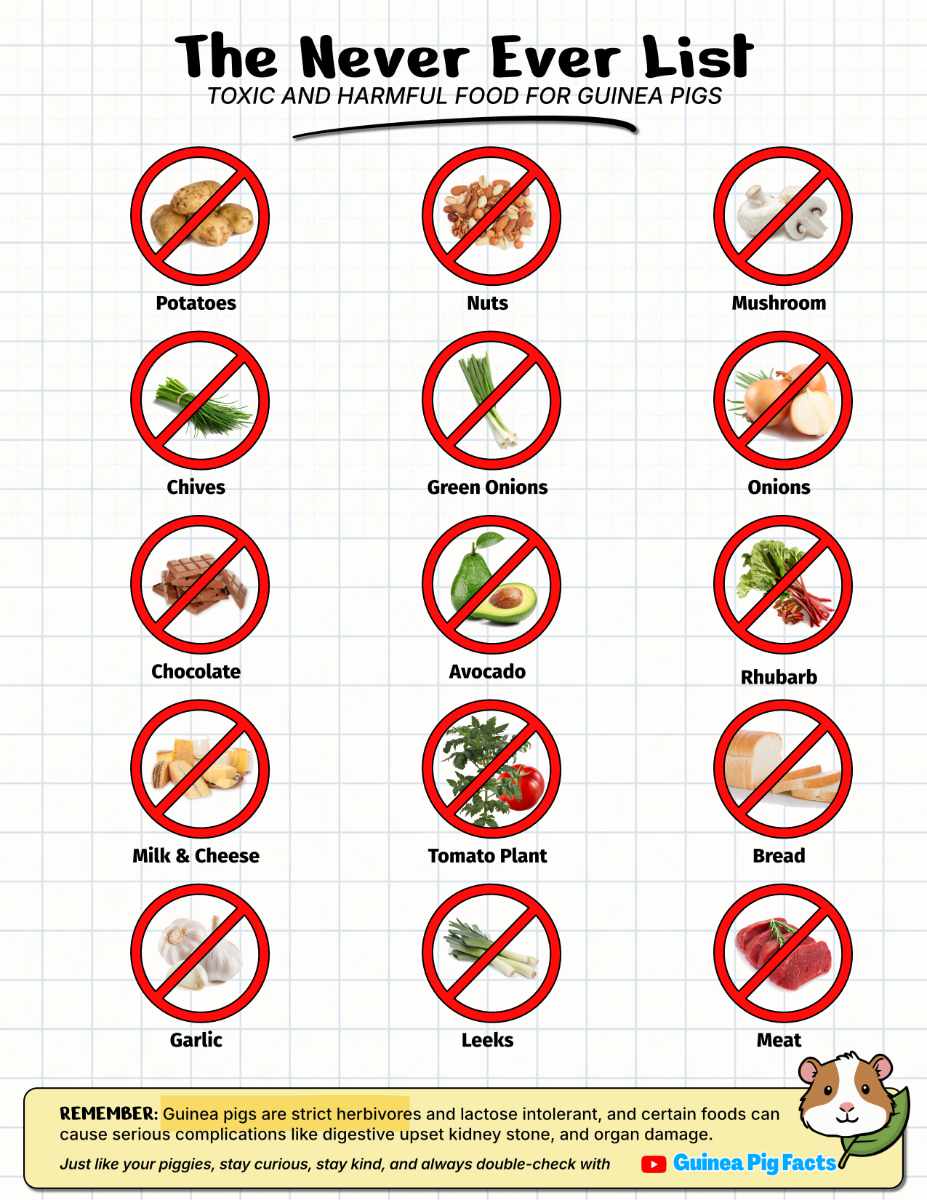
The toxic foods that should never go in your guinea pig’s bowl.
Know what to feed and what to avoid, plan meals easily, and run daily and weekly health checks.
Serving sizes are per guinea pig. Nutrition is per 100 g of the raw food (USDA data where available). This list is general guidance for healthy adult guinea pigs, not veterinary advice. If your piggy has a health condition, check with your vet.